Home energy technologies - a trader's guide
 In this article
How to futureproof your trade as greener heating solutions start to replace gas boilers in the race to net zero
The way we heat our homes is changing. Currently, around 18% of the UK's carbon dioxide emissions come from keeping our homes warm. Most of this can be attributed to gas boilers, with 86% of homes using gas heating in 2023-24. The UK government’s plans to reach net zero by 2050 are ambitious, and rely on the home energy sector updating supply chains and products as efficiently as possible.
While the government has abandoned plans to ban the sale of gas boilers from 2035, its Warm Homes Plan launched in January 2026 includes providing low and zero-interest loans that homeowners will be able to apply for to install heat pumps as an alternative to boilers. They will also be available for solar panels and batteries.
These loans will make it easier for homeowners to pay for renewable installations, driving demand for traders who can install them. The government said it will announce details of how consumers can apply for these loans later in 2026.
The Boiler Upgrade Scheme (BUS) in England and Wales was also expanded in November 2025 to include grants of £2,500 towards the cost of installing air-to-air heat pumps and heat batteries.
The scheme already provides homeowners with a grant of £7,500 to install an air-source or ground-source heat pump, or £5,000 towards a biomass boiler. There’s a similar scheme in Scotland.
Gas boilers: what are the alternative home energy technologies?
The public demand for renewables and energy-efficient alternatives is increasing. According to figures from the Microgeneration Certification Scheme (MCS), the number of renewable installations in UK homes and small businesses was the highest ever in 2025.
There were 369,000 installations, including 60,000 heat pumps – the most ever fitted in one year. Demand for solar panels and battery storage were also record breaking.
‘The government’s aspirations and ambitions to reduce our carbon footprint are admirable,’ says Kevin Wellman, chief executive officer for the Chartered Institute of Plumbing and Heating Engineering (CIPHE), ‘and we are all duty bound to help with that, because firstly, we can help to save the planet, but secondly, it should hopefully reduce our fuel costs, given the right designs.’
Heat pumps, immersion boilers, hydrogen boilers and electric fires are all greener alternatives to gas boilers and other carbon-intensive home-heating systems.
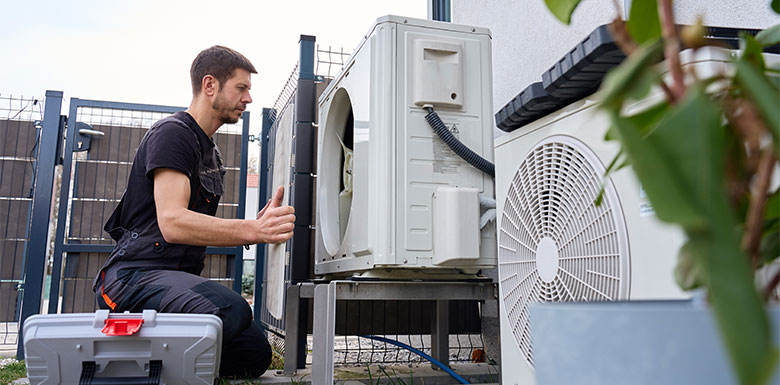
Heat pumps are the front-runner of low-carbon home heating alternatives. Heat pumps themselves do not emit any carbon dioxide. They are available as air-source or ground-source, with many other tangible benefits. They’re also efficient - for every unit of energy put in, you get around three units of heat out.
‘Air-source heat pumps have an efficiency rating of around 300%, while ground-source heat pumps can have efficiency ratings above 400%,’ says a spokesperson from Heatable. ‘Compare this to gas boilers that have an efficiency rating of around 90%, meaning that they can only convert 90% of the energy it uses to heat, while 10% is completely wasted.’
Read more: Heat pumps vs boilers
‘Heat pumps have a large role to play but there are a range of possible renewable heating options for consumers and the best application should be evaluated on a case-by-case basis,’ says Frank Gordon from the Renewable Energy Association (REA).
‘For example, larger, older properties off the gas grid could benefit from biomass boilers – a proven technology that has been around for decades – and there are newer electrified heating options under development.’
Hydrogen boilers would look and behave the same way as gas boilers, burning the fuel. But there are safety concerns, and supply pipes would all have to be hydrogen-ready. Plus, hydrogen production isn't carbon-free. Truly green hydrogen is possible, but it's expensive and needs 100% renewable electricity.
A controversial trial of hydrogen home heating is due to take place in Fife, Scotland, where 300 homes in a specific area will have the option of connecting to a new hydrogen gas network.
In its Warm Homes Plan, the government said it would consult on its assessment of whether hydrogen should play a role in home heating in the future. However, it said its role is likely to be limited as it’s not a technology that’s proven for this purpose.
Why has heat pump take up been slow?
The government has a target of 450,000 heat pump installations a year by 2030 – a significant reduction from the 600,000 a year by 2028 set by the Conservative government in 2020. But consumer take-up has been slow.
The biggest stumbling blocks for consumers signing up to new home energy technology, and heat pumps in particular, are perhaps cost and awareness.
To contribute towards the cost, the Boiler Upgrade Scheme provides £7,500 towards an air-source heat pump (ASHP) or ground-source heat pump (GSHP) in England and Wales. The heat pump installer doing the work, who must be MCS-certified, applies for the grant on the homeowner’s behalf.
The Home Energy Scotland Grant and Loan offers homeowners in Scotland a grant of £7,500, or £9,000 in rural areas, towards a heat pump. They can also access the same amount again in interest-free loans, paid back over a total of up to 10 years if no additional loans for energy efficiency measures are taken out.
Energy Saving Trust states that the average gas boiler installation costs around £3,700, with a heat pump currently costing around £11,000 for an air-source heat pump and around £29,000 for a ground-source heat pump. These costs don’t include any government funding contributions.
The most recent BUS stats for January 2026 show that since applications for grants opened for the scheme on 23 May 2022, there has been a total of 114,022 BUS voucher applications received up to the end of January 2026 - 98% of which were for grants towards air-source heat pump installations. For vouchers that were redeemed in the last quarter of 2025, the median cost of a BUS installation of an ASHP was £13,431.
‘While new-build heat pump installations will happen automatically in the future, more work needs to be done to bring down costs and increase consumer support for the retrofit heat pump market,’ says Frank at REA.
How can net zero targets benefit my trade?
The government has set a large target of 450,000 heat pump installations per year by 2030. In 2025, there were only 60,000 installed in homes and small businesses, making the UK one of the slowest in Europe to embrace the technology. According to the Heat Pump Association UK (HPA UK), there were a total of around 125,000 heat pump sales in 2025.
The missing link? A bigger workforce - and a grand opportunity for traders to upskill and expand their offering. According to figures published in the Warm Homes Plan, there are around 10,000 trained and active heat pump installers in the UK, with 4,000 of these full-time equivalent (FTE). The number of FTE installers needs to increase to 12,000 by 2030 to keep up with demand – three times the current number.
The Heat Training Grant has been available since July 2023. It provides grants of up to £500 for heating engineers in England to train as heat pump installers. Funding for the scheme is being increased to £7m a year for the next three years – up from £5m this financial year – increasing training opportunities if you’re a heating engineer wanting to upskill.
‘There is a fundamental need for net zero-related re-skilling and re-training across the industry,’ says Frank at REA.
‘This is a fast-moving area and we recommend energy traders sign up to an accredited consumer protection scheme, like the Renewable Energy Consumer Code (RECC),’ Frank continues. ‘This will ensure consumers are receiving the best possible experience. It will also keep traders’ training up to date and help them follow the latest industry developments and changes in legislation and technical requirements.’
How can I encourage my customers to install heat pumps?
For now, gas boilers can still be fitted in existing homes. Given newer models are more energy efficient than older ones, and often have smart heating controls, new gas boilers are certainly still an energy-saving solution compared with older models.
They’re also cheaper to install than heat pumps and fitting one avoids the extra disruption involved in switching to a new type of heating. This makes choosing to fit a gas boiler rather than a heat pump easier when an old boiler breaks down and a quick decision has to be made.
Homeowners who plan ahead to replace their old heating system will have more time to consider alternatives and may be more likely to install a heat pump instead. So how can you convince your customers of the benefits of planning ahead?
A survey by Which? in October 2025, with support from the MCS Foundation, revealed the messages most likely to engage homeowners with the idea.
As cost is one of the biggest issues, messages about financial support, such as that upgrading to a heat pump can be made more affordable with government grants and loans, was found to be most effective.
The second most effective were messages around the benefits of planning ahead to install a new heating system before your current one breaks down and leaves you without heating or hot water. Combining this message with the financial one was found to engage 85% of homeowners.
Planning ahead to replace their heating system at the same time as doing other home improvements to minimise disruption was the third most compelling message.
Find out more about our research on the messages likely to drive earlier boiler replacement planning.
If you fit other kinds of renewable technologies or energy efficiency measures, some of these messages are likely to be effective at encouraging homeowners to plan ahead for those too.
Further benefits to upskilling in green energy installation
For consumers, sustainable home energy doesn’t stop at heat pump purchase and installation. Heat pumps produce water at lower temperatures than gas boilers, so they might consider the need for larger radiators, better insulation, double glazing, and even solar panels - all at further cost.
- Find out more: how do solar panels work?
‘Solar PV panels and heat pumps combined are a great partnership, as the electricity provided by the solar PV panels is used to run the heat pump,’ says Charlotte Lee, CEO of HPA UK. ‘This is further supported by the battery storage to enable the heat pumps to use the electricity generated by the solar PV panels during periods where the sun is not shining.’
It is important, then, to consider all new home energy technologies, not just heating methods.
‘A package of measures will achieve the best results,’ says Frank of REA. ‘Net zero means thinking holistically and traders have a great opportunity to do so, and increase the value of their sales, too. A common understanding and recognition of the importance of green projects to the building trade is essential – delivering on net zero helps futureproof the whole industry, not just for installers, but for related trades, like glaziers.’
Adding to this, Ernie Rea of Vantage Windows and Doors, says: ‘When considering net zero targets and new ways of supplying energy to homes, it is essential to combine various energy technologies, including energy-efficient windows and doors. This approach helps homeowners achieve maximum energy efficiency and reduce carbon emissions, making their homes more sustainable.’